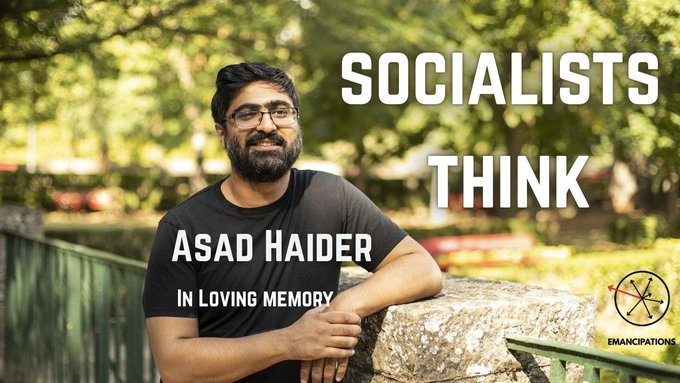
The intellectual and activist community is reeling after the heartbreaking news of Asad Haider’s passing, a loss felt profoundly across movements he helped shape. For many, Haider was not simply a writer or theorist — he was a compass, a steadying force in a political landscape often fractured by division and dogmatism.
For countless young organizers, particularly those navigating the complexities of class, race, and identity, Haider’s work provided a rare clarity. His ideas offered more than analysis; they offered permission — permission to think deeply, to resist the pressure of political purity, and to reject the false binaries that have long plagued the left.
One mourner described him as “one of the most important figures for me as a young Marxist trying to understand what it meant to be a committed Marxist and a Black girl from a diverse working-class community while the left was tearing itself apart over ‘race vs. class’ debates.” Haider’s writing, they said, helped them free themselves from political moralism and step away from the suffocating politics of authenticity.
Haider approached political life with a combination of intellectual rigor and unmistakable compassion — a balance that made space for genuine solidarity. He believed deeply in humanity’s potential, not as an abstract ideal but as a practical, lived possibility. That belief animated his work and inspired others to struggle not out of guilt or moral necessity, but out of love.
He reminded readers and comrades alike that we are not bound by the identities imposed upon us, nor by the roles history assigns. Transformation, he insisted, begins with the individual and expands outward, reshaping the world in the process.
His words — widely cited today as friends and colleagues grapple with his loss — continue to echo with the optimism and resolve that characterized his work:
“You showed up. You are at a meeting. Your presence is an indication that it is possible to initiate the process of change. Do not allow yourself to be intimidated by guilt. Instead, sharpen your analysis and enhance your organization, until your ranks grow so large as to include everyone.”
Asad Haider leaves behind a legacy of thought that challenged stagnation, and a model of political engagement rooted in belief — belief in people, in possibility, and in the long arc of liberation. His absence leaves a painful void, but his work continues to guide, comfort, and mobilize those committed to building a world worthy of all of us.