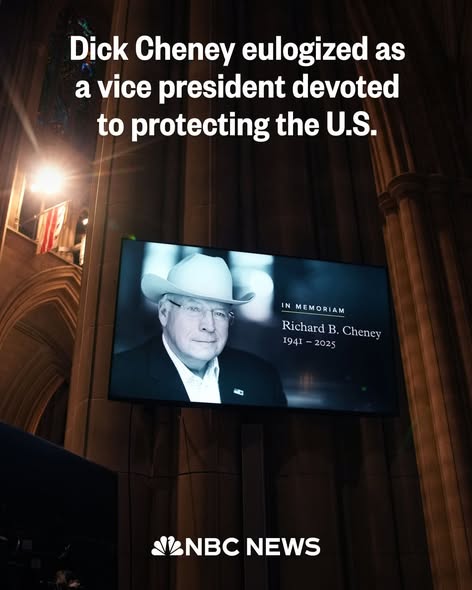
In a solemn gathering at the Washington National Cathedral, leaders, dignitaries, and loved ones came together this week to honor the life and legacy of former Vice President Dick Cheney, passed away earlier this month at the age of 84. His career, spanning more than five decades, left a profound impact on American foreign policy, national security strategy, and the broader landscape of U.S. public service.
Cheney, long regarded as one of the most influential and consequential policymakers of the modern era, was a central figure in shaping America’s military and diplomatic posture. He played pivotal roles in the two Bush administrations, helping oversee the invasion of Panama and the first Gulf War during President George H.W. Bush’s tenure, and later serving as vice president during George W. Bush’s two terms—years defined by the Sept. 11, 2001 attacks and the global war on terror that followed.
Friends and colleagues remembered him as a deeply committed, intensely driven public servant whose focus never wavered.
During her eulogy, former Rep. Liz Cheney spoke movingly about her father’s devotion to the nation he served and the values that guided him throughout his life.
“Though he was inspired to service by President Kennedy, Dick Cheney became a Republican,” she said. “But he knew that bonds of party must always yield to the single bond we share as Americans. For him, a choice between defense of the Constitution and defense of your political party was no choice at all.”
She also reflected on the unique childhood she and her sister experienced—one shaped by the routines, responsibilities, and privileges of growing up with a father immersed in shaping U.S. history.
Those who attended described the service as a thoughtful tribute to a man whose influence, admired or debated, was undeniably far-reaching. The ceremony honored not only Cheney’s work in government but also the private man—devoted husband, father, and grandfather—known to those closest to him.
As the nation looks back on the milestones and controversies of his career, the legacy of Dick Cheney remains a testament to the complexities of leadership in turbulent times—and to a lifetime spent at the center of America’s most consequential decisions.